
For intravenous use only
- The first and only IV iron FDA-approved to treat iron deficiency in adult patients with heart failure (HF) and New York Heart Association (NYHA) class II/III to improve exercise capacity1
- Preservative-free
- Vial closure not made with natural rubber latex
For more information about Injectafer, including BOXED WARNING please see below and visit www.injectaferhcp.com
| Pack NDC# | Strength | Supplied as | Shelf pack | Vial opening size | Product info | Availability | ||
|---|---|---|---|---|---|---|---|---|
|
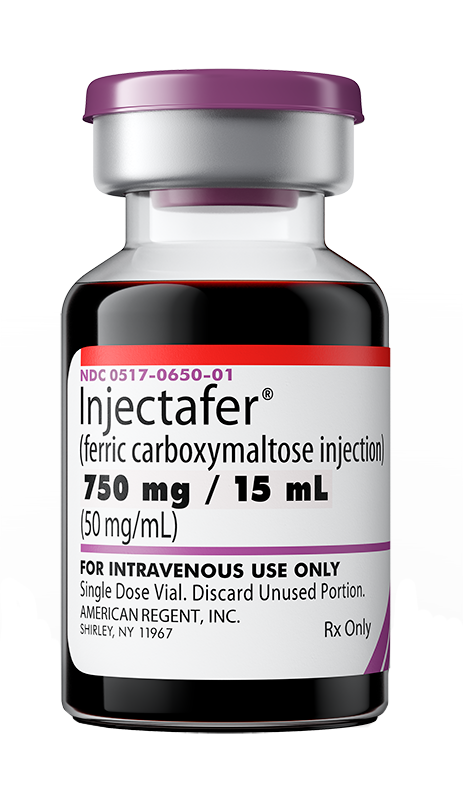
Strength:
750 mg iron/ 15 mL |
0517-0650-01 |
750 mg iron/ |
15 mL |
1 | 20 mm | Product Label Full Prescribing Information Safety Data Sheet | In-Stock Shipping Weekly | |
Product Label Full Prescribing Information Safety Data Sheet Wholesaler Numbers
Case Information
|
||||||||
|
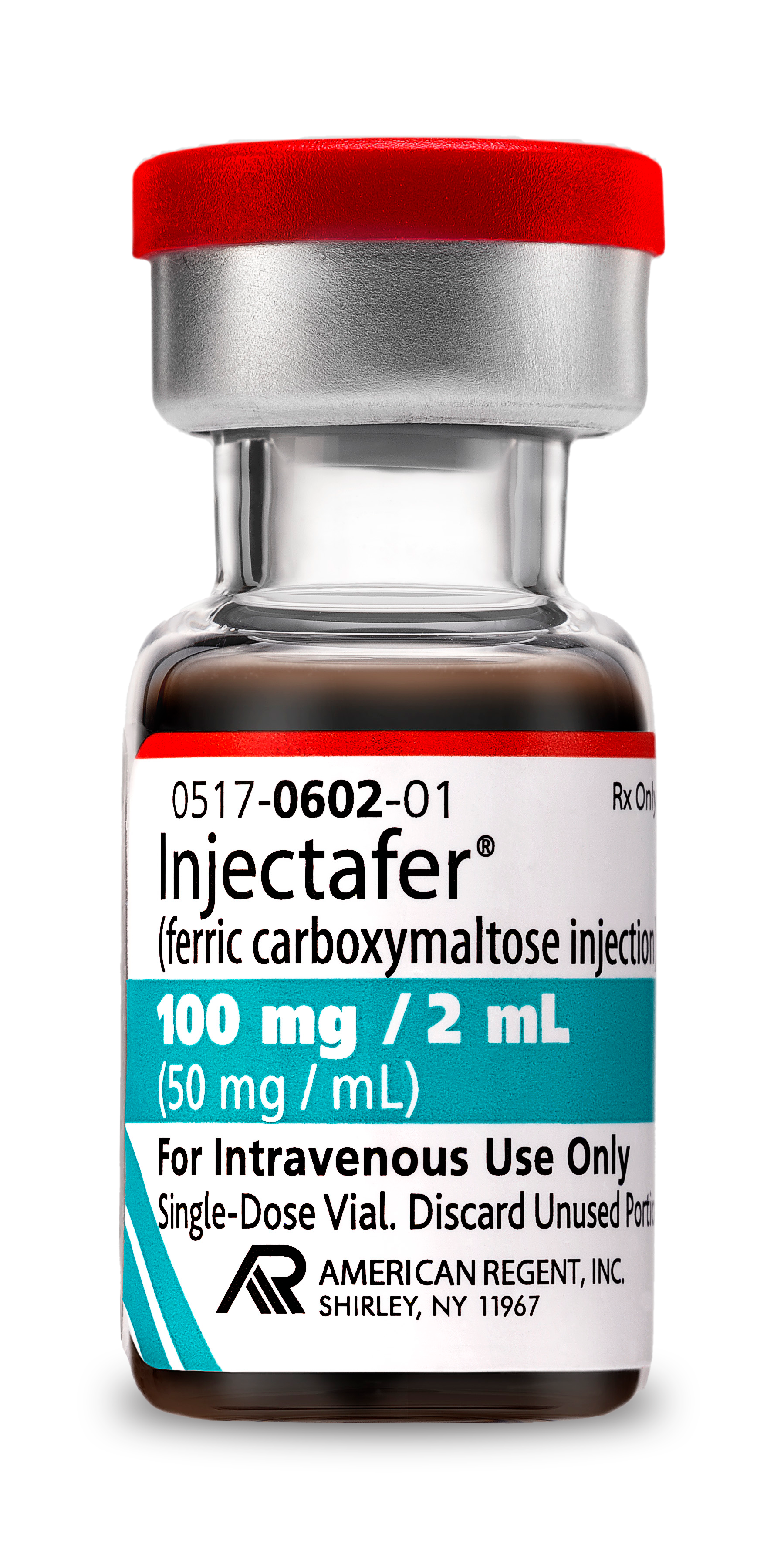
Strength:
100 mg iron/ 2 mL |
0517-0602-01 |
100 mg iron/ |
2 mL |
1 | 13 mm | Product Label Full Prescribing Information Safety Data Sheet | In-Stock Shipping Weekly | |
Product Label Full Prescribing Information Safety Data Sheet Wholesaler Numbers
Case Information
|
||||||||
|
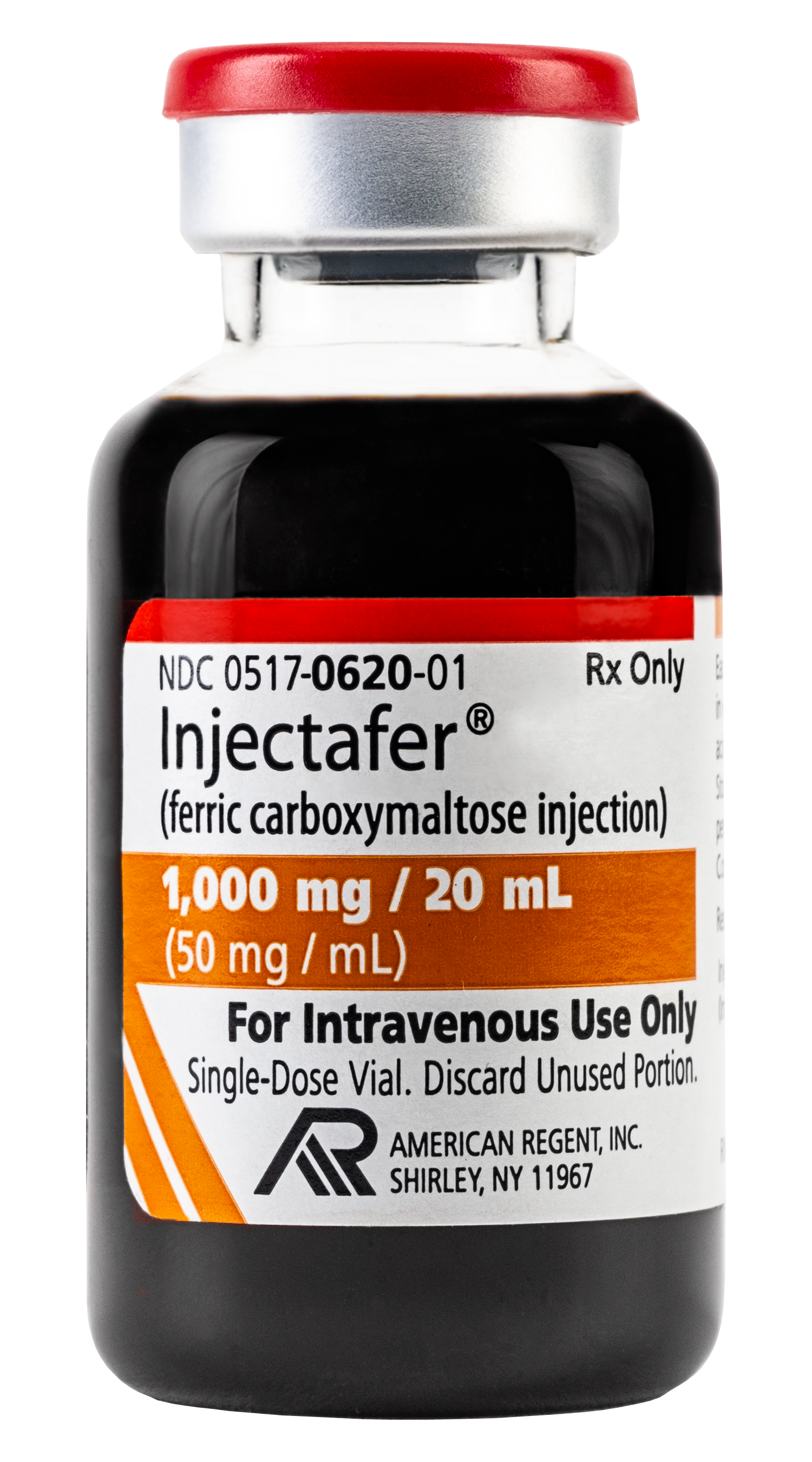
Strength:
1000 mg iron/ 20 mL |
0517-0620-01 |
1000 mg iron/ |
20 mL |
1 | 20 mm | Product Label Full Prescribing Information Safety Data Sheet | In-Stock Shipping Weekly | |
Product Label Full Prescribing Information Safety Data Sheet Wholesaler Numbers
Case Information
|
||||||||
View product patent information.
REFERENCE:
1. Injectafer (ferric carboxymaltose injection). Package insert. American Regent, Inc.
Injectafer and the Injectafer logo are registered trademarks of Vifor (International) Inc., Switzerland.
Contact Us
By clicking Submit, you confirm that you accept our Privacy Policy and that you agree to your personal contact information being used to contact you and added to our database. If at any time you wish your personal information to be removed from the American Regent® database, please submit a message request to corpcommunications@americanregent.com.
- INJECTAFER can cause severe, prolonged hypophosphatemia associated with serious outcomes, including hospitalization, osteomalacia, and fractures requiring clinical intervention.
- Hypophosphatemia has occurred in patients with normal baseline phosphate levels and without apparent risk factors for hypophosphatemia.
- Check serum phosphate levels prior to a repeat course of treatment in patients at risk for low serum phosphate and in any patient who receives a repeat course of therapy within three months. Correct pre-existing hypophosphatemia prior to administering INJECTAFER.
- Advise patients receiving INJECTAFER about the risk of hypophosphatemia and to report any signs and symptoms of hypophosphatemia (e.g., fatigue, muscle weakness or pain, bone and joint pain, bone fractures).
CONTRAINDICATIONS
INJECTAFER is contraindicated in patients with hypersensitivity to INJECTAFER or any of its inactive components.
WARNINGS AND PRECAUTIONS
Symptomatic Hypophosphatemia
Symptomatic hypophosphatemia, including severe cases, with serious outcomes such as osteomalacia and fractures requiring clinical intervention have occurred in patients treated with INJECTAFER in the post-marketing setting. These cases have occurred after single and multiple doses of INJECTAFER. Risk factors for hypophosphatemia include a history of gastrointestinal disorders associated with malabsorption of fat-soluble vitamins or phosphate, inflammatory bowel disease, concurrent or prior use of medications that affect proximal renal tubular function, hyperparathyroidism, vitamin D deficiency, malnutrition, and hereditary hemorrhagic telangiectasia (HHT or Osler-Weber-Rendu syndrome). However, individuals without apparent risk factors have experienced symptomatic hypophosphatemia. In most cases, hypophosphatemia resolved within three months.
Check serum phosphate levels prior to a repeat course of treatment if the patient is at risk for low serum phosphate or if the patient will receive a repeat course of therapy within three months of the prior course. Correct pre-existing hypophosphatemia prior to administering INJECTAFER. Monitor serum phosphate levels in patients at risk for chronic low serum phosphate. Treat hypophosphatemia as medically indicated.
Consider permanent discontinuation of INJECTAFER for severe symptomatic hypophosphatemia or persistent hypophosphatemia.
Hypersensitivity Reactions
Serious hypersensitivity reactions, including anaphylactic-type reactions, some of which have been life-threatening and fatal, have been reported in patients receiving INJECTAFER. Patients may present with shock, clinically significant hypotension, loss of consciousness, and/or collapse. Monitor patients for signs and symptoms of hypersensitivity during and after INJECTAFER administration for at least 30 minutes and until clinically stable following completion of the infusion. Only administer INJECTAFER when personnel and therapies are immediately available for the treatment of serious hypersensitivity reactions. In clinical trials, serious anaphylactic/anaphylactoid reactions were reported in 0.1% (2/1775) of subjects receiving INJECTAFER. Other serious or severe adverse reactions potentially associated with hypersensitivity which included, but were not limited to, pruritus, rash, urticaria, wheezing, or hypotension were reported in 1.5% (26/1775) of these subjects.
Hypertension
In clinical studies, hypertension was reported in 4% (67/1775) of subjects in clinical trials 1 and 2. Transient elevations in systolic blood pressure, sometimes occurring with facial flushing, dizziness, or nausea were observed in 6% (106/1775) of subjects in these two clinical trials. These elevations generally occurred immediately after dosing and resolved within 30 minutes. Monitor patients for signs and symptoms of hypertension following each INJECTAFER administration.
Laboratory Test Alterations
In the 24 hours following administration of INJECTAFER, laboratory assays may overestimate serum iron and transferrin bound iron by also measuring the iron in INJECTAFER.
ADVERSE REACTIONS
The most common adverse reactions in adult patients (>2%) are nausea, hypertension, flushing, injection site reactions, erythema, hypophosphatemia, and dizziness.
The most common adverse reactions in pediatric patients (≥4%) are hypophosphatemia, injection site reactions, rash, headache, and vomiting.
Post-Marketing Experience
Adverse reactions have been identified during post approval use of INJECTAFER. Because these reactions are reported voluntarily from a population of uncertain size, it is not always possible to reliably estimate their frequency or establish a causal relationship to drug exposure.
The following adverse reactions have been reported from the post-marketing spontaneous reports with INJECTAFER: cardiac disorders: tachycardia; general disorders and administration site conditions: chest discomfort, chills, pyrexia; metabolism and nutrition disorders: hypophosphatemia; musculoskeletal and connective tissue disorders: arthralgia, back pain, hypophosphatemic osteomalacia; nervous system disorders: syncope; respiratory, thoracic, and mediastinal disorders: dyspnea; skin and subcutaneous tissue disorders: angioedema, erythema, pruritus, urticaria; pregnancy: fetal bradycardia.
USE IN SPECIFIC POPULATIONS
Pregnancy – Fetal/Neonatal Adverse Reactions
Severe adverse reactions including circulatory failure (severe hypotension, shock including in the context of anaphylactic reaction) may occur in pregnant women with parenteral iron products (such as INJECTAFER), which may cause fetal bradycardia, especially during the second and third trimester.
INDICATIONS
INJECTAFER® (ferric carboxymaltose injection) is indicated for the treatment of iron deficiency anemia (IDA) in adult and pediatric patients 1 year of age and older who have either intolerance or an unsatisfactory response to oral iron, and in adult patients who have non-dialysis-dependent chronic kidney disease. INJECTAFER is also indicated for iron deficiency in adult patients with heart failure and New York Heart Association class II/III to improve exercise capacity.
Please see Full Prescribing Information, including BOXED WARNING.
You are encouraged to report Adverse Drug Events to American Regent, Inc.® at 1-800-734-9236 or to the FDA by visiting www.fda.gov/medwatch or calling 1-800-FDA-1088.
REF-2472 (v8.0) 8/2026