Methylergonovine MaleateInjection, USP
For intramuscular or intravenous administration
- Preservative-free
- Vial closure is not made with natural rubber latex
| Pack NDC# | Strength | Supplied as | Shelf pack | Vial opening size | Product info | Availability | ||
|---|---|---|---|---|---|---|---|---|
|
Strength:
0.2 mg/mL Supplied As:1 mL |
0517-0740-20 |
0.2 mg/mL |
1 mL |
20 | 13 mm | Product Label Full Prescribing Information Safety Data Sheet | Limited Stock Shipping Weekly | |
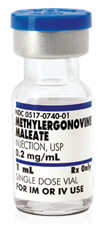
Product Label Full Prescribing Information Safety Data Sheet Wholesaler Numbers
Case Information
|
||||||||
Contact Us
By clicking Submit, you confirm that you accept our Privacy Policy and that you agree to your personal contact information being used to contact you and added to our database. If at any time you wish your personal information to be removed from the American Regent® database, please submit a message request to corpcommunications@americanregent.com.
CONTRAINDICATIONS
Methylergonovine Maleate Injection is contraindicated in patients with hypertension; toxemia; pregnancy; and hypersensitivity.
WARNINGS AND PRECAUTIONS
General
This drug should not be administered IV routinely because of the possibility of inducing sudden hypertensive and cerebrovascular accidents. If IV administration is considered essential as a lifesaving measure, methylergonovine maleate should be given slowly over a period of no less than 60 seconds with careful monitoring of blood pressure. Intra-arterial or periarterial injection should be strictly avoided.
Caution should be exercised in the presence of sepsis, obliterative vascular disease. Also use with caution during the second stage of labor. The necessity for manual removal of a retained placenta should occur only rarely with proper technique and adequate allowance of time for its spontaneous separation.
Coronary Artery Disease
Patients with coronary artery disease or risk factors for coronary artery disease (eg, smoking, obesity, diabetes, high cholesterol) may be more susceptible to developing myocardial ischemia and infarction associated with methylergonovine-induced vasospasm.
Risk of Adverse Reactions or Reduced Therapeutic Effect Due to Drug Interactions
The concomitant use of methylergonovine maleate and certain drugs may result in potentially significant drug interactions, some of which may lead to adverse reactions or reduced therapeutic effect of methylergonovine maleate or the concomitant drug.
Medication Errors
Inadvertent administration of methylergonovine maleate to newborn infants has been reported. In these cases of inadvertent neonatal exposure, symptoms such as respiratory depression, convulsions, cyanosis, and oliguria have been reported. Usual treatment is symptomatic. However, in severe cases, respiratory and cardiovascular support is required.
Due to the potential for accidental neonatal exposure, methylergonovine maleate injection should be stored separately from medications intended for neonatal administration.
DRUG INTERACTIONS
CYP3A4 inhibitors (eg, macrolide antibiotics and protease inhibitors)
There have been rare reports of serious adverse events in connection with the coadministration of certain ergot alkaloid drugs (eg, dihydroergotamine and ergotamine) and potent CYP3A4 inhibitors, resulting in vasospasm leading to cerebral ischemia and/or ischemia of the extremities. Although there have been no reports of such interactions with methylergonovine alone, strong and moderate CYP3A4 inhibitors should not be co-administered with methylergonovine.
CYP3A4 inducers
Drugs (eg, nevirapine, rifampin) that are strong inducers of CYP3A4 are likely to decrease the pharmacological action of methylergonovine maleate.
Beta-blockers
Caution should be exercised when methylergonovine maleate is used concurrently with beta-blockers. Concomitant administration with beta-blockers may enhance the vasoconstrictive action of ergot alkaloids.
Anesthetics
Anesthetics, like halothane and methoxyflurane, may reduce the oxytocic potency of methylergonovine maleate.
Glyceryl trinitrate and other antianginal drugs
Methylergonovine maleate produces vasoconstriction and can be expected to reduce the effect of glyceryl trinitrate and other antianginal drugs.
Caution should be exercised when methylergonovine maleate is used concurrently with other vasoconstrictors, ergot alkaloids, or prostaglandins.
USE IN SPECIFIC POPULATIONS
Pregnancy
Use of methylergonovine maleate is contraindicated during pregnancy because of its uterotonic effects.
Animal reproductive studies have not been conducted with methylergonovine maleate. It is not known whether methylergonovine maleate can cause fetal harm or can affect reproductive capacity.
Labor and Delivery
The uterotonic effect of methylergonovine maleate is utilized after delivery to assist involution and decrease hemorrhage, shortening the third stage of labor. Caution should be exercised during the second stage of labor. The necessity for manual removal of a retained placenta should occur only rarely with proper technique and adequate allowance of time for its spontaneous separation.
Nursing Mothers
Mothers should not breastfeed during treatment with methylergonovine maleate and at least 12 hours after administration of the last dose. Milk secreted during this period should be discarded. Methylergonovine maleate may produce adverse effects in the breastfeeding infant. Methylergonovine maleate may also reduce the yield of breast milk.
Hepatic Impairment
Use with caution in patients with hepatic impairment.
Renal Impairment
Use with caution in patients with renal impairment.
ADVERSE REACTIONS
Common Adverse Reactions
The most common adverse reaction is hypertension associated in several cases with seizure and/or headache. Hypotension has also been reported. Abdominal pain (caused by uterine contractions), nausea, and vomiting have occurred occasionally.
Rare Adverse Reactions
Rarely observed reactions have included: acute myocardial infarction, transient chest pains, vasoconstriction, vasospasm, coronary arterial spasm, bradycardia, tachycardia, dyspnea, hematuria, thrombophlebitis, water intoxication, hallucinations, leg cramps, dizziness, tinnitus, nasal congestion, diarrhea, diaphoresis, palpitation, rash, and foul taste.
There have been rare, isolated reports of anaphylaxis, without a proven causal relationship to the drug product.
Postmarketing Experience
The following adverse drug reactions have been derived from post-marketing experience with methylergonovine maleate via spontaneous case reports. Because these reactions are reported voluntarily from a population of uncertain size, it is not possible to reliably estimate their frequency, which is therefore categorized as not known.
Nervous System Disorders
Cerebrovascular accident, paraesthesia.
Cardiac Disorders
Ventricular fibrillation, ventricular tachycardia, angina pectoris, atrioventricular block.
INDICATIONS AND USAGE
Following delivery of the placenta, for routine management of uterine atony, hemorrhage, and subinvolution of the uterus. For control of uterine hemorrhage in the second stage of labor following delivery of the anterior shoulder.
For additional safety information, please see Full Prescribing Information.
You are encouraged to report Adverse Drug Events to American Regent Inc. at 1-800-734-9236 or to the FDA by visiting www.fda.gov/medwatch or calling 1-800-FDA-1088.
REF-0638 (v4.0) 8/2025